Case Study
AI Friction Finder
Designing an AI-powered prospecting pipeline to surface strategic product friction in SaaS companies
My role
AI Product Designer
Scope
Discovery, user research, workflow design, prototype design and validation.
Regulated Med-Tech | AI Software | B2B | SaaS
Regulated Med-Tech | AI Software | B2B | SaaS
COntext
I run a fractional product design practice alongside full-time employment, targeting SaaS companies that need senior-level design thinking without the overhead of a full-time hire. The challenge with fractional consulting is outreach: most designers pitch on portfolio aesthetics or generic UX credentials, which reads as noise to a busy product or founding team.
I wanted to flip that. Instead of leading with what I do, I wanted to lead with what I already know about each company's product before I'd spoken to anyone there. The only way to do that at scale, without spending hours on manual research, was to build it.
Friction Finder is a seven-module automated pipeline built in Make.com and powered by Claude via Anthropic's native API.
It scrapes a target company's homepage and pricing page, generates a strategic company brief, identifies five evidenced product friction points across four analytical lenses, and drafts a personalised outreach email, all written back automatically to a Google Sheet.
Built solo, in approximately two weeks, with no prior experience in Make.com or complex automation.
I wanted to flip that. Instead of leading with what I do, I wanted to lead with what I already know about each company's product before I'd spoken to anyone there. The only way to do that at scale, without spending hours on manual research, was to build it.
Friction Finder is a seven-module automated pipeline built in Make.com and powered by Claude via Anthropic's native API.
It scrapes a target company's homepage and pricing page, generates a strategic company brief, identifies five evidenced product friction points across four analytical lenses, and drafts a personalised outreach email, all written back automatically to a Google Sheet.
Built solo, in approximately two weeks, with no prior experience in Make.com or complex automation.
Problem
Two problems sit underneath this project, one practical and one strategic.
The practical problem: Manual prospecting is slow and generic. Researching a company, forming a view on their product strategy, and drafting a credible, specific outreach message takes one to two hours per company. At fractional rates and fractional hours, that's not viable.
The strategic problem: Most designer outreach addresses what a product looks like. Broken padding, inconsistent components, unclear CTAs. These are real issues, but they're not the issues a founding team or CPO loses sleep over.
The more valuable conversation is strategic:
Is your audience too broad to convert efficiently?
Is your AI differentiator already being commoditised?
Are you building a moat, or a feature?
The pipeline was designed to have that second conversation, automatically and at scale.
The practical problem: Manual prospecting is slow and generic. Researching a company, forming a view on their product strategy, and drafting a credible, specific outreach message takes one to two hours per company. At fractional rates and fractional hours, that's not viable.
The strategic problem: Most designer outreach addresses what a product looks like. Broken padding, inconsistent components, unclear CTAs. These are real issues, but they're not the issues a founding team or CPO loses sleep over.
The more valuable conversation is strategic:
Is your audience too broad to convert efficiently?
Is your AI differentiator already being commoditised?
Are you building a moat, or a feature?
The pipeline was designed to have that second conversation, automatically and at scale.
What i built
The pipeline runs in sequence, triggered by adding a new row to a Google Sheet:
Google Sheets trigger: watches for a new prospect row with company name, URL, and contact details. These companies are scraped by Claude which creates a TSV file in the format that fits the google sheet.
Homepage scrape: Fetches raw HTML, strips scripts and metadata, truncates to 8,000 characters.
Pricing page scrape: Same process applied to the pricing URL.
Company Brief module: Claude generates a structured brief covering stage, business model, and positioning summary.
Friction Points module: Claude analyses across four lenses: Audience Specificity, Product Moat, UX and Workflow Friction, and Retention and Growth Risks.
Friction Points Review: A second Claude module analyses claudes initial friction points and checks data to avoid hullicination and incorrect assumptions.
Outreach Draft module: Claude writes a personalised email leading with the single most relevant friction point.
Google Sheets write-back: All outputs are written back to the corresponding row automatically.
Each Claude module uses Anthropic's native Make.com integration, which handles JSON escaping of HTML content automatically, a detail that caused persistent failures when using raw HTTP requests early in the build.
Google Sheets trigger: watches for a new prospect row with company name, URL, and contact details. These companies are scraped by Claude which creates a TSV file in the format that fits the google sheet.
Homepage scrape: Fetches raw HTML, strips scripts and metadata, truncates to 8,000 characters.
Pricing page scrape: Same process applied to the pricing URL.
Company Brief module: Claude generates a structured brief covering stage, business model, and positioning summary.
Friction Points module: Claude analyses across four lenses: Audience Specificity, Product Moat, UX and Workflow Friction, and Retention and Growth Risks.
Friction Points Review: A second Claude module analyses claudes initial friction points and checks data to avoid hullicination and incorrect assumptions.
Outreach Draft module: Claude writes a personalised email leading with the single most relevant friction point.
Google Sheets write-back: All outputs are written back to the corresponding row automatically.
Each Claude module uses Anthropic's native Make.com integration, which handles JSON escaping of HTML content automatically, a detail that caused persistent failures when using raw HTTP requests early in the build.
The Hard Problem: Hallucination as a Product Design Problem
The most consequential design decision in this project wasn't about automation logic or prompt structure. It was about trust.
During testing, the pipeline generated a friction point that referenced a specific detail that wasn't present on the actual pricing page. The claim was plausible, internally consistent, and confidently written. It was also wrong. Had that made it into outreach, it would have ended the conversation before it started and damaged credibility with a prospect.
This is not a fringe risk with AI-generated research. It is the central risk. A pipeline that produces fast, fluent, hallucinated analysis is worse than no pipeline at all.
The response was structural, not cosmetic.
Two interventions were built into the system:
First, a self-review layer was added to the Friction Points prompt. After generating each friction point, the model is required to verify that every specific claim is directly evidenced by the scraped content provided, not inferred, assumed, or recalled from training data.
Each point is confirmed or flagged before the output is written to the sheet.
Second, a dedicated verification agent module sitting between the Friction Points and Outreach Draft modules. This agent cross-checks every specific claim against the raw scraped content independently, before any output reaches a human.
The insight here translates directly to product design practice: an AI feature that users cannot trust is an activation problem, not a capability problem. The design work is building the checkpoint architecture that earns that trust.
During testing, the pipeline generated a friction point that referenced a specific detail that wasn't present on the actual pricing page. The claim was plausible, internally consistent, and confidently written. It was also wrong. Had that made it into outreach, it would have ended the conversation before it started and damaged credibility with a prospect.
This is not a fringe risk with AI-generated research. It is the central risk. A pipeline that produces fast, fluent, hallucinated analysis is worse than no pipeline at all.
The response was structural, not cosmetic.
Two interventions were built into the system:
First, a self-review layer was added to the Friction Points prompt. After generating each friction point, the model is required to verify that every specific claim is directly evidenced by the scraped content provided, not inferred, assumed, or recalled from training data.
Each point is confirmed or flagged before the output is written to the sheet.
Second, a dedicated verification agent module sitting between the Friction Points and Outreach Draft modules. This agent cross-checks every specific claim against the raw scraped content independently, before any output reaches a human.
The insight here translates directly to product design practice: an AI feature that users cannot trust is an activation problem, not a capability problem. The design work is building the checkpoint architecture that earns that trust.


The Strategic Lens: What the Pipeline Actually Looks For
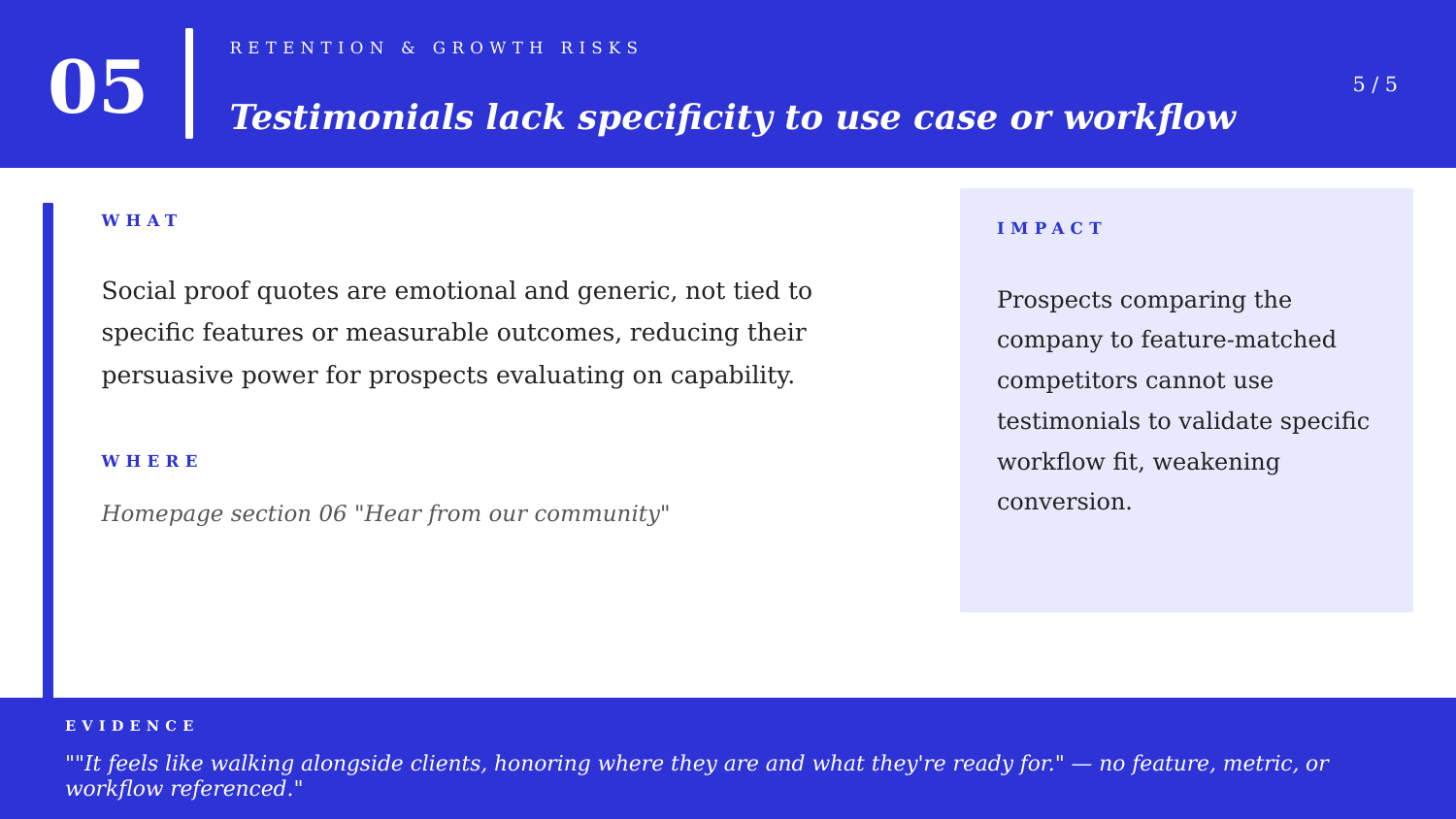
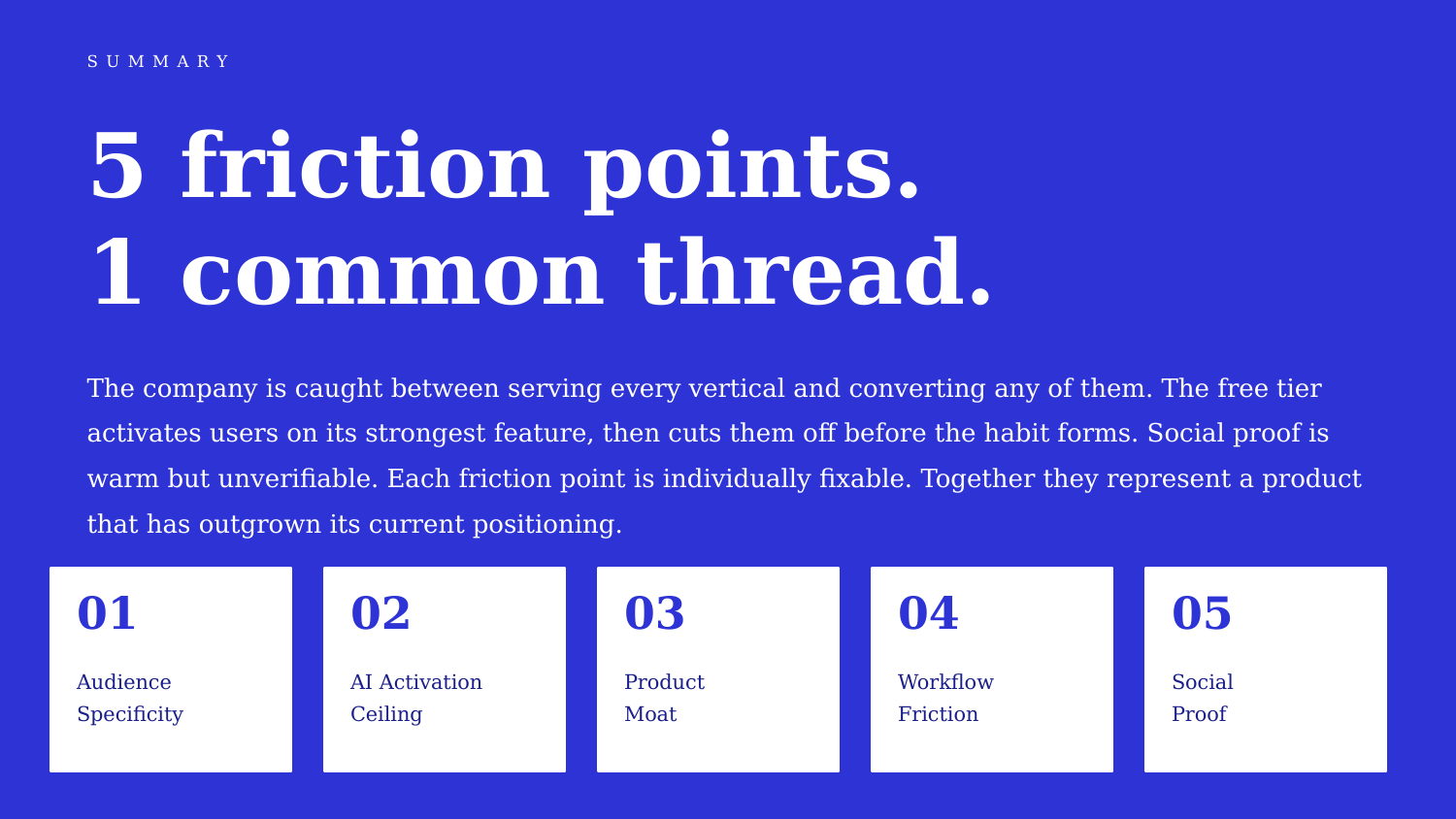
The four analytical lenses were chosen specifically to surface business-level concerns, not UI-level symptoms.
Audience Specificity
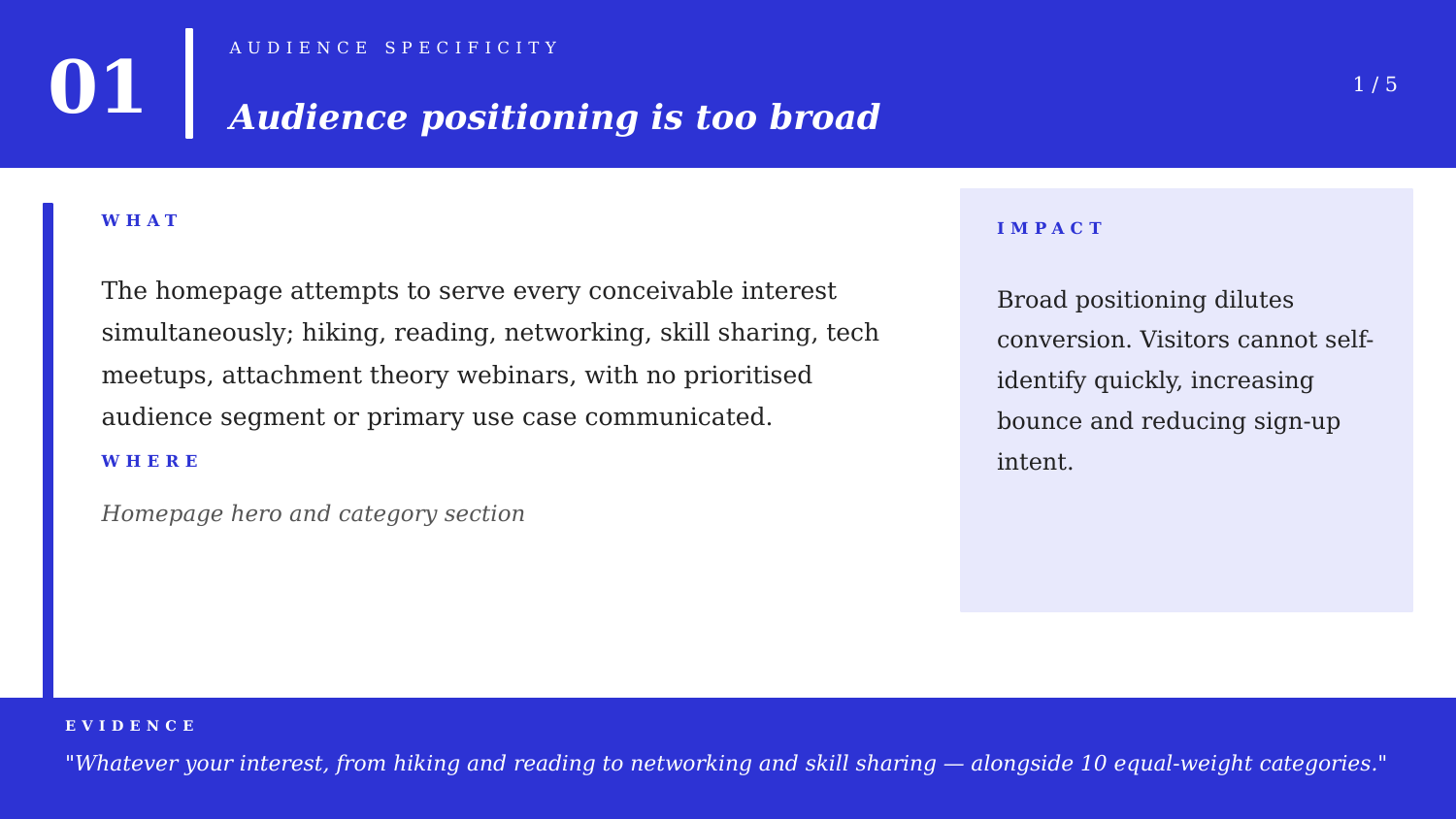
Asks whether the product's messaging is tight enough to convert. A platform targeting eight accommodation types, or four healthcare verticals simultaneously, will struggle to make any single visitor feel the product was built for them.
This dilutes paid acquisition efficiency and suppresses conversion before the product is ever experienced.
This dilutes paid acquisition efficiency and suppresses conversion before the product is ever experienced.
Product Moat
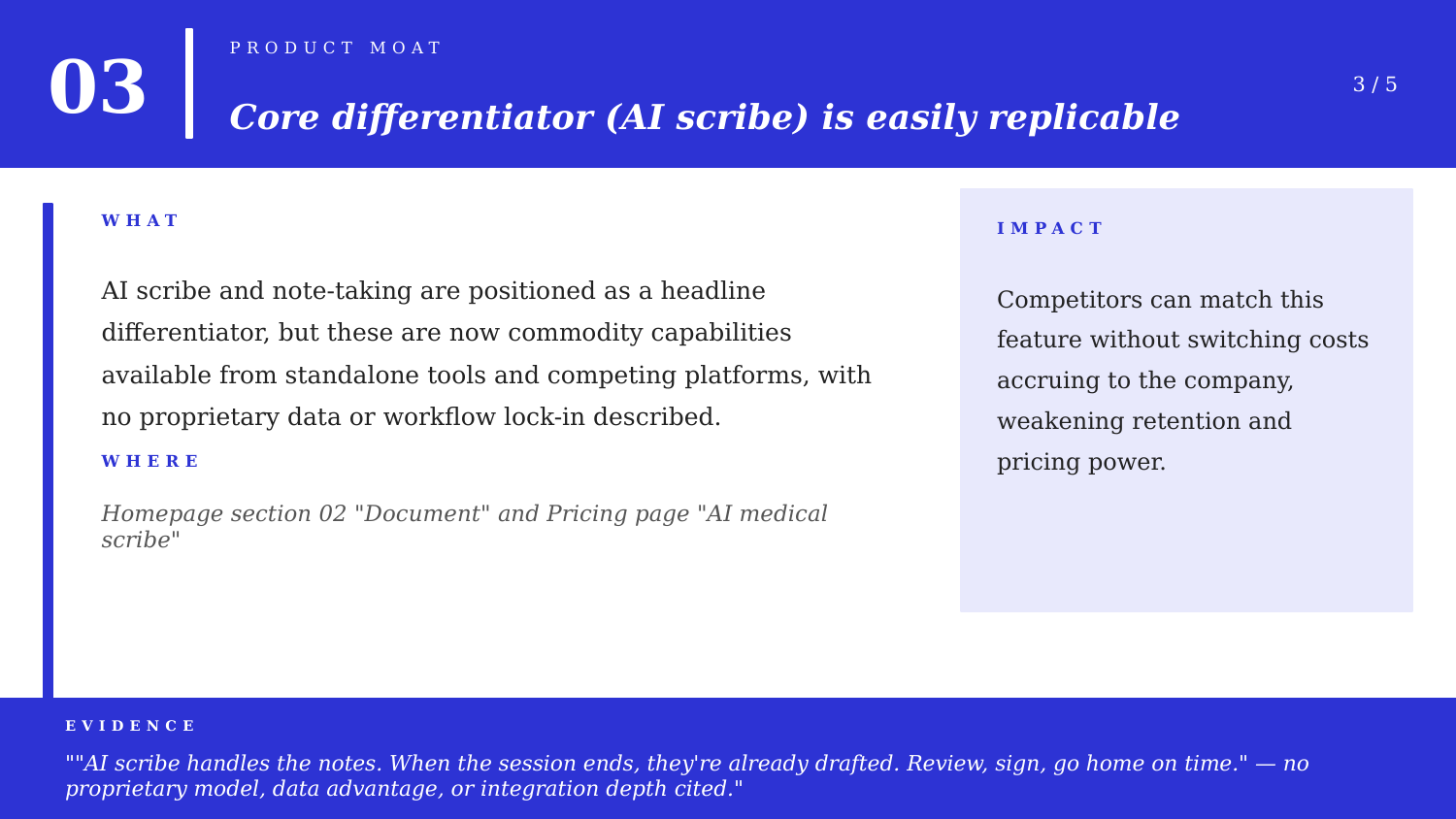
Asks whether the core differentiator is defensible. In a world where AI scribing, channel management, and invoicing are all rapidly becoming commodity features, a product that leads with these claims without demonstrating proprietary data, network effects, or switching costs has a positioning problem that no redesign will fix.
Retention & Growth Risks
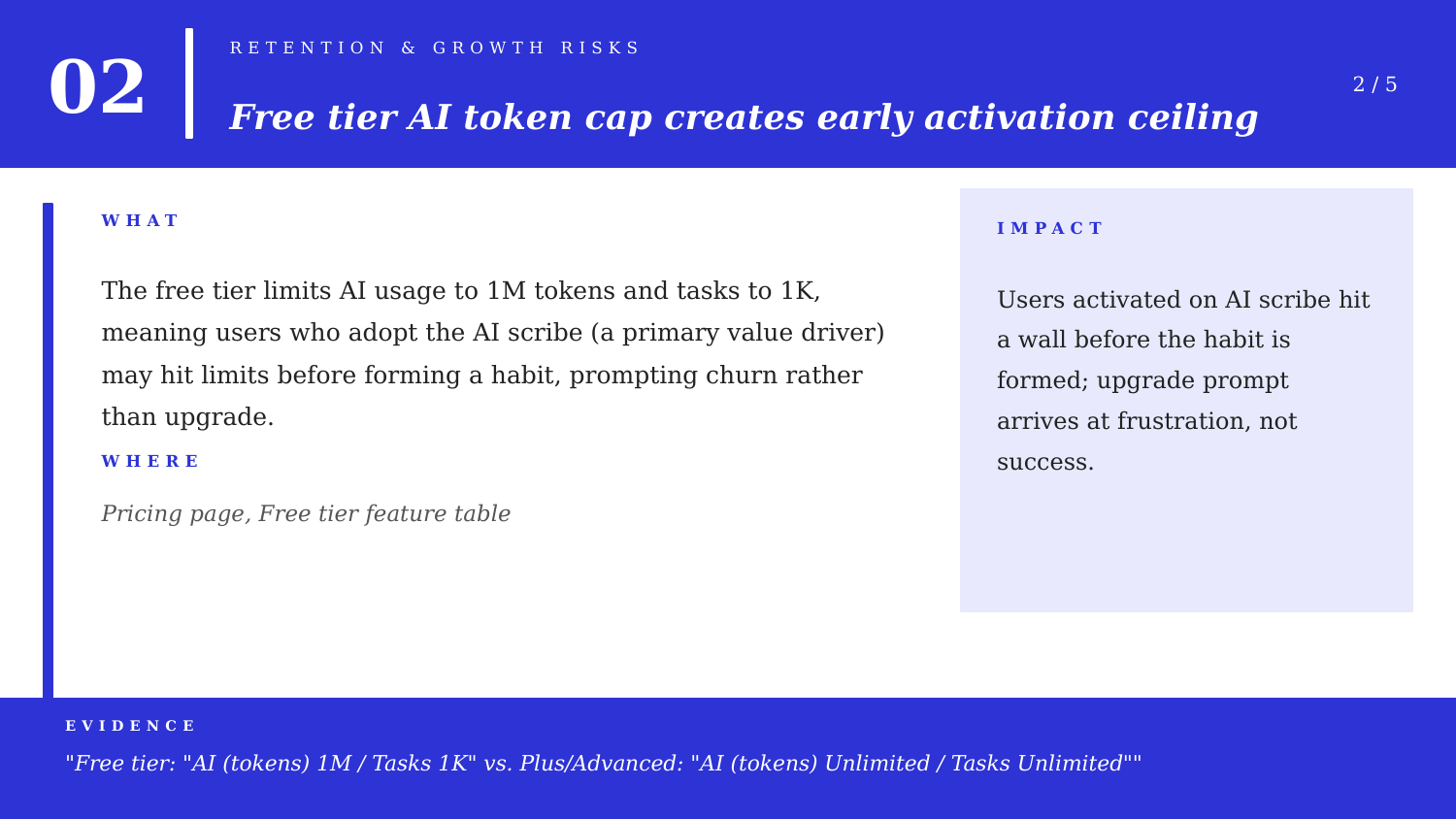
Asks where the upgrade logic is breaking down. Token caps that cut off AI usage before a habit forms. Attachment limits that are identical across all pricing tiers. Trial windows too short for a complex workflow tool to prove its value.
UX & Workflow Friction
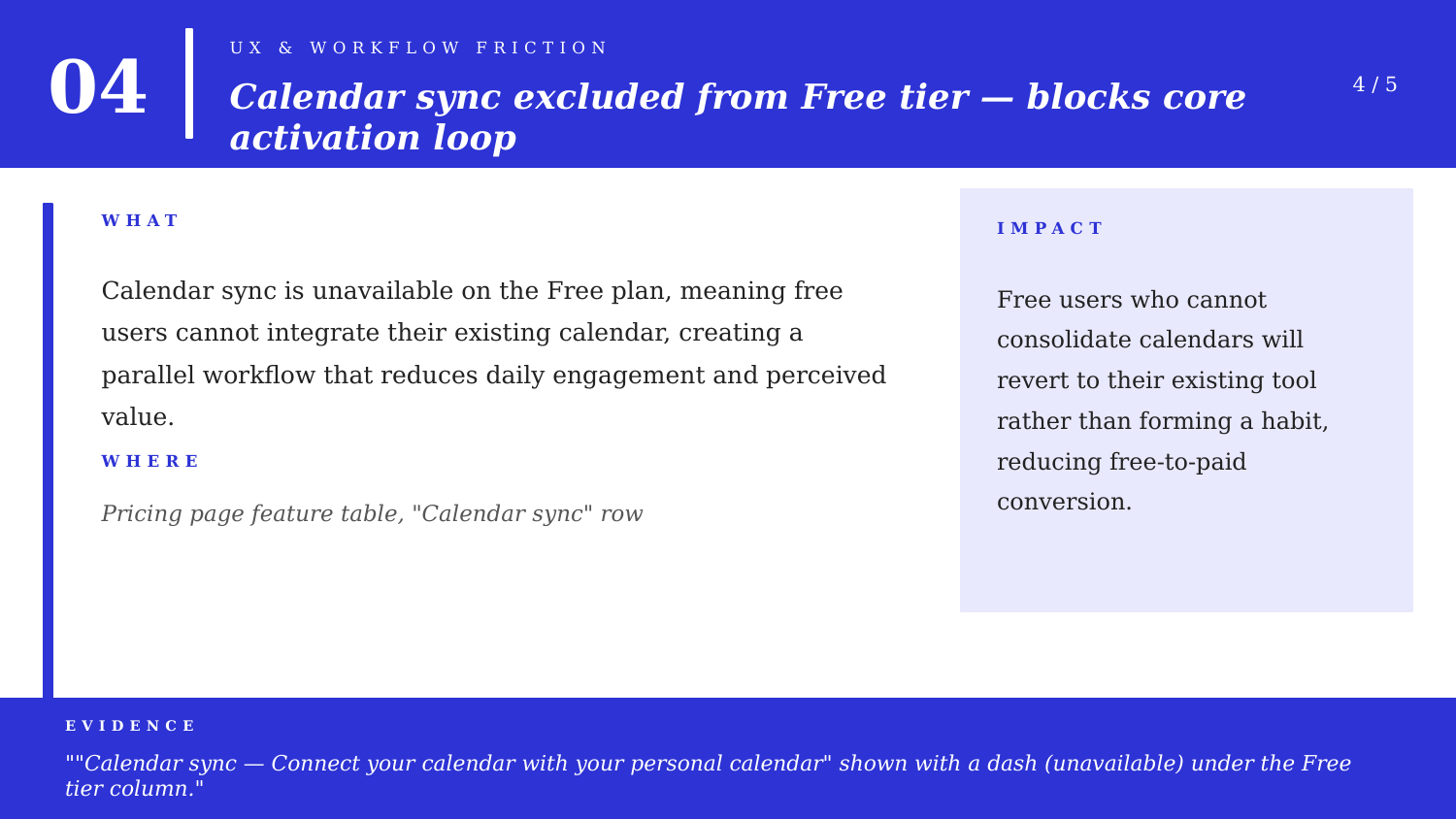
Asks where the experience is actively working against conversion, but at a systemic level rather than a component level. Pricing pages that display three different price points for the same plan. Broken discount rendering showing "undefined% off" at the exact moment a user is deciding whether to buy.
In Practice: Five Companies, Five Diagnoses
The pipeline has been run against five SaaS companies to date. Each produced five evidenced friction points. Company names are withheld; the strategic patterns are what matter.
Healthcare practice management SaaS:
The platform targets four clinical verticals simultaneously with undifferentiated messaging. More critically, the AI scribe, positioned as the headline differentiator, is now a commodity capability with no proprietary model, data advantage, or integration depth cited. The real moat opportunity is clinical specificity: SOAP vs. DAP vs. BIRP note structures differ by discipline. A platform that writes physiotherapy notes the way a physio thinks, and psychology notes the way a psychologist thinks, is harder to replicate than one that writes AI-assisted notes generically.
Privacy tools suite (12 products):
With twelve products given equal visual weight and CTAs on the homepage, there is no guided entry point for a new user. Separately, the pricing page was rendering broken discount labels and no prices across every plan card, meaning users who had decided to upgrade could not complete that decision. These are different classes of problem, one strategic and one operational, and the pipeline surfaced both in a single pass.
Vacation rental SaaS:
Three different price points for the same plan appeared on a single scroll of the pricing page, with the booking fee contradicting itself in different sections. At the exact moment a user is evaluating whether to start a trial, the pricing page was actively undermining confidence in the company's transparency.
Business banking for SMEs:
The activation drop between account opened and first invoice sent is where most players in this space lose users. The platform has the right building blocks, but the breadth creates onboarding complexity for solo operators who didn't sign up to become their own finance team.
Service marketplace:
Scaling a platform with real utility across a fragmented market, but the experience that converts that utility into habitual use, for professionals building their pipeline and consumers who return rather than defaulting to a search engine, is the design problem the pipeline identified as most pressing.
Healthcare practice management SaaS:
The platform targets four clinical verticals simultaneously with undifferentiated messaging. More critically, the AI scribe, positioned as the headline differentiator, is now a commodity capability with no proprietary model, data advantage, or integration depth cited. The real moat opportunity is clinical specificity: SOAP vs. DAP vs. BIRP note structures differ by discipline. A platform that writes physiotherapy notes the way a physio thinks, and psychology notes the way a psychologist thinks, is harder to replicate than one that writes AI-assisted notes generically.
Privacy tools suite (12 products):
With twelve products given equal visual weight and CTAs on the homepage, there is no guided entry point for a new user. Separately, the pricing page was rendering broken discount labels and no prices across every plan card, meaning users who had decided to upgrade could not complete that decision. These are different classes of problem, one strategic and one operational, and the pipeline surfaced both in a single pass.
Vacation rental SaaS:
Three different price points for the same plan appeared on a single scroll of the pricing page, with the booking fee contradicting itself in different sections. At the exact moment a user is evaluating whether to start a trial, the pricing page was actively undermining confidence in the company's transparency.
Business banking for SMEs:
The activation drop between account opened and first invoice sent is where most players in this space lose users. The platform has the right building blocks, but the breadth creates onboarding complexity for solo operators who didn't sign up to become their own finance team.
Service marketplace:
Scaling a platform with real utility across a fragmented market, but the experience that converts that utility into habitual use, for professionals building their pipeline and consumers who return rather than defaulting to a search engine, is the design problem the pipeline identified as most pressing.




























































































































Constraints and Trade-offs
HTML quality determines output quality. The pipeline is only as good as the content it can scrape. Dynamic pages that render pricing client-side will return empty plan cards. Pages with heavy script bloat require aggressive stripping and truncation. Some prospects required manual content extraction before the pipeline could run effectively.
Speed versus depth. The pipeline produces fast, structured, evidenced analysis. It does not replace extended product immersion. The friction points are a starting point for a conversation, not a complete diagnosis. The outreach workflow is designed with this in mind: the pipeline does the research, a human writes the final email.
Automation versus authenticity. Fully automated outreach was a deliberate non-goal. The pipeline drafts; the designer sends. This keeps the human judgment and voice at the point where it matters most, the moment a real person is deciding whether to reply.
Speed versus depth. The pipeline produces fast, structured, evidenced analysis. It does not replace extended product immersion. The friction points are a starting point for a conversation, not a complete diagnosis. The outreach workflow is designed with this in mind: the pipeline does the research, a human writes the final email.
Automation versus authenticity. Fully automated outreach was a deliberate non-goal. The pipeline drafts; the designer sends. This keeps the human judgment and voice at the point where it matters most, the moment a real person is deciding whether to reply.

Learnings and Outcomes
AI for strategy, not aesthetics
The most durable skill a senior product designer can offer a SaaS company is not only visual execution. It is the ability to read a product's business model, positioning, and activation logic, and identify where they are working against each other.
This pipeline is a demonstration of that thinking, applied systematically.
Hallucination discipline is a transferable design principle
The verification layer built here, prompt-level self-review, planned agent-level cross-check, is the same kind of trust architecture that AI product teams are building inside their own products. Having designed it from scratch, with real stakes, is more instructive than knowing it in theory.
Building with unfamiliar tools is part of the job
Make.com, Anthropic's API via native modules, JSON escaping constraints, Google Sheets trigger logic, none of this was prior knowledge. The ability to identify the right tool, learn it under real constraints, and ship something that works is the skill. The specific tools are secondary.
Outreach built on research converts differently
Friction Finder is an ongoing project. The verification agent module is in development.
New prospects are added to the pipeline regularly.
The most durable skill a senior product designer can offer a SaaS company is not only visual execution. It is the ability to read a product's business model, positioning, and activation logic, and identify where they are working against each other.
This pipeline is a demonstration of that thinking, applied systematically.
Hallucination discipline is a transferable design principle
The verification layer built here, prompt-level self-review, planned agent-level cross-check, is the same kind of trust architecture that AI product teams are building inside their own products. Having designed it from scratch, with real stakes, is more instructive than knowing it in theory.
Building with unfamiliar tools is part of the job
Make.com, Anthropic's API via native modules, JSON escaping constraints, Google Sheets trigger logic, none of this was prior knowledge. The ability to identify the right tool, learn it under real constraints, and ship something that works is the skill. The specific tools are secondary.
Outreach built on research converts differently
Friction Finder is an ongoing project. The verification agent module is in development.
New prospects are added to the pipeline regularly.
.gif)
.png)